Sunday, December 7, 2014

The Golden Monkeys of the New World

Source: Google Images
Kingdom:Animalia
Phylum:Chordata
Class:Mammalia
Order:Primates
Family:Callitrichidae
Genus:Leontopithecus
Species:L. rosalia
The golden lion tamarin, Leontopithecus rosalia, is an endangered primate native to the Atlantic Forest of Brazil, in South America. However, its habitat has been reduced to approximately 5% of its original size due to deforestation, predation, and illegal poaching. Luckily, through conservation efforts, translocation, and reintroduction programs, this little monkey is making a comeback along the coastal areas of Brazil and its numbers are slowly increasing.

Physiology:
The golden lion tamarin belongs to the family callitrichidae, a group of new world monkeys that includes marmosets and tamarins. It is the largest of the callitrichines, weighing in at approximately 1.3 pounds and the length of their body being somewhere between six and ten inches, not including the ten to sixteen inch tail. They get their name from the distinctive reddish gold hairs that surround their face and ears, creating a brilliant mane around their dark, hairless face. The golden color of their hair is thought to be caused by the sunlight and the organic pigments found in their food. Unlike old world monkeys and apes, who have flat finger and toe nails, the golden lion tamarin and all other new world monkeys have tegulae (1), small claw-like nails that allows the monkey to easily cling to the bark of trees and branches. Their sharp claws, combined with their prehensile tail, are the monkeys mode of transportation, allowing them to quickly travel among the branches in which they live, jumping from tree to tree, and even running, squirrel-like, through the treetops. Golden lion tamarins are not sexually dimorphic, so both male and the female monkeys are both relatively the same size and color.

Behavior:
In the wild, golden lion tamarins live in groups of two to eleven, with the average group number ranging around five. However, average group sizes have decreased in recent years due to high levels of predation. The social structure of the group varies, but always includes one dominant male and female breeding pair. Most dominant males are monogamous, breeding with only one female, but occasionally they will exhibit polygamous behavior and breed with two females, usually a mother/daughter pair. In addition to the ruling pair, there will be several subadult, juvenile, and infant members of the group that are usually offspring of the dominant breeding pair. If there is more than one adult male in the group, one asserts his dominance over the other via physical violence and by
Source: The Guardian
"arch walking", where the dominant male will arch his back while walking on all fours, much like a frightened cat. Dominant relationships among the group are determined by a seniority ranking. Those who have been in the group territory longer have a higher hierarchical ranking. For example, if an immigrant male finds his way into the group, a young female who has inherited her mother's breeding position will have dominance over him. Furthermore, females within a group may be related to one another, but males can be non-natal, which is to say they were not born into the group. The logic behind this hinges on the dispersal patterns of adult monkeys. At the age of four, both males and females leave their original group, forming single sex groups and looking for a group they can immigrate into. However, in order to do so, a vacancy must appear in a group, leaving a spot open to be taken over by a new member. For example, if a dominant female dies, her daughter moves up to take her place. Rather than mating with his daughter, the dominant male moves out, leaving an open space available for a new male to move up in rank or an immigrant male to move in. An immigrant male may also take over a group by challenging the reigning, male leader and winning. Two males, usually brothers are sometimes observed taking over a group, while one becomes dominant and asserts his power over the other. Unfortunately for females, those who disperse do not often make it into a new group and usually die or disappear before finding a new home. However, family groups are hostile towards one another, with the dominant male and female behaving violently towards imposing strangers and trespassers (3).

Ecology:
Golden lion tamarins are omnivorous, eating everything from fruits and flowers to birds eggs, insects, and small vertebrates. Although much of their original habitat has been destroyed, small microhabitats exist within their current range, including bromeliads, vine tangles, and rotting logs, that are important to the monkeys' foraging habits and living patterns. The tamarins use their elongated fingers to catch small prey hiding in crevices and underneath leaves. Insects, however,only make up approximately 15% of their diet, while a considerably larger portion of their diet consists of fruit, found in the leafy tree tops. During the dry season, when fruit and insects are not as abundant, they must rely on other sources of food, such as nectar, gum, and small animals, usually reptiles.
Source: Flickr
Because of their reliance on insects and fruit as a food source, golden lion tamarins are often referred to as fauni-frugivores, an animal that specializes in eating fruits.  Also, because they feed on fruits and flowers, they are important to plant germination and seed dispersal. Acting as a transportation device for pollen and seeds (4). The monkeys spend their days foraging food, starting with fruit in the morning and moving on to foraging for insects and resting in the afternoon. As the afternoon progresses, they spend the rest of the day traveling to their nighttime nesting sights, where they sleep in groups, usually in hollow tree cavities or in dense vines. During the warmer, wetter season, the tamarins start their foraging earlier and end it later than they do during the colder, drier season. Although most callitrichines depend on gums and saps as a staple part of their diet, golden lion tamarins only rely on them as a supplementary source, only eating it when other food sources are low.

Habitat and Distribution:
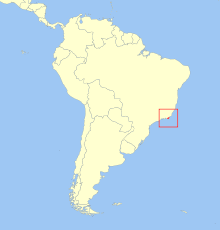
The golden lion tamarin is native to the rain forests of Eastern Brazil, specifically, the Atlantic Coastal Forest. Because of deforestation, they have lost all but approximately 5% of their original habitat and are now limited to three specific areas, Poço (POH-so) das Antas Biological Reserve, Fazenda União Biological Reserve, and some private land through the Reintroduction Program. In Poço das Antas (5), they prefer swamp jungle, situated no more than 300 ft. above sea level, which contains many vines, bromeliads, and a high density of both fruit and animal food sources. Because
Source: Wikipedia

all of this land originally fell victim to the logging industry, it is not as it once was, so it is not well known what the monkeys preferred before they were thrust into that situation. It is assumed that they preferred a humid, closed canopy forest with a large amount of vegetation that would provide pathways through the trees and protection from airborne predators. A population estimate back in 1972 decided that there were approximately between 400 and 500 golden lion tamarins in the wild. A more recent count in 1981 determined the number to be less than 200 and an even more recent estimate has found that numbers have increased to be, at most, 400 individuals (2). 


Conservation:
The golden lion tamarin was first placed on the endangered species list by the International Union for Conservation of Nature (IUCN) in 1982. Not long after, in 1984, the National Zoological Park in Washington D.C. and the World Wide Fund for Nature (WWF) started a reintroduction program through the Golden Lion Tamarin Association. This program enlisted the help of 140 zoos, worldwide, to breed and reintroduce golden lion tamarins back into the wild in order to boost wild populations. Despite the success of this project, the IUCN increased the level of endangerment to critically endangered in 1996. Deforestation, illegal poaching, and urbanization are some of the main reasons that there has been such a sharp decline in numbers. However, organizations, such as the Nation Zoo, has worked diligently to help bring these numbers back up, through specialized breeding programs, reintroduction, and translocation. By increasing the wild populations by reintroduction and maintaining large breeding groups in captivity, the conservation efforts have succeeded. However, deforestation and poaching are still fierce competitors and the battle is continual (1). 

Works Cited:
  1. Golden lion tamarin. (2014, November 30). Retrieved December 2, 2014, from http://en.wikipedia.org/wiki/Golden_lion_tamarin
  2. About Golden Lion Tamarins - National Zoo| FONZ. (n.d.). Retrieved December 2, 2014, from http://nationalzoo.si.edu/SCBI/EndangeredSpecies/GLTProgram/Learn/
  3. Golden lion tamarinLeontopithecus rosalia. (n.d.). Retrieved December 2, 2014, from http://pin.primate.wisc.edu/factsheets/entry/golden_lion_tamarin
  4. Lapenta, M. J., De Oliveira, P. P., Kierluff, M. C., & Motta-Junior, J. C. (2003). Fruit exploitation by golden lion tamarins (leontopithecus rosalia) in the uniao biological reserve, rio das ostras, rj - brazil. Mammalia. Retrieved from http://www.micoleao.org.br/arquivos/artigos/Lapenta%20et%20al_2003.pdf
  5. Leontopithecus rosalia. (n.d.). Retrieved December 8, 2014, from http://www.iucnredlist.org/details/11506/0


The Chinese Giant Salamander


 The Chinese giant salamander, or Andrias davidianus, is the one of the largest amphibians in the world. Its' classification is as follows:
Phylum: Chordata
Class: Amphibia
Order: Caudata
Family: Cryptobranchidae

           The Cryptobranchid family encompasses three species of giant salamander, all of which are among the largest in the world. Andrias davidianus lives in the mountain streams of China at elevations below 1,500 feet. More specifically, one may find a Chinese giant salamander in the Yangtze, Yellow,and Pearl Rivers and their tributaries. This species prefers cold, fast running mountain streams and lives in muddy, dark rock crevices. It is also a nocturnal species, preying on its food mostly at night. Due to over exploitation and fragmentation of their environment, the Chinese giant salamander is currently listed as critically endangered by the IUCN (International Union on Conservation of Nature). The Yangtze River basin alone is home to 480 million people, or nearly one third of China’s total population. The high density of humans in this basin puts added stress on the river systems, which need to be protected in order to save the Chinese giant salamander. Because of the growing population, the Chinese giant salamander is loosing valuable habitat, and the habitat it does have left is becoming polluted. Overhunting also poses a major threat to this species as it is considered a Chinese delicacy.
            Another recent possible factor contributing to the decline of this species is the iridovirus. During the summer months in 2010, researchers raising populations of Andrias davidianus in China in mountain caves and ditches for conservation reasons found a 95% mortality rate in one group. More specifically, the most affected populations were those living in ditches. Some effects of the iridovirus include swelling, emaciation, ulcers and erythema on the dorsal and ventral body surfaces, toe necrosis, darkened livers, and lesions on the kidney and spleen. Scientists were able to isolate the iridovirus from the liver and spleen to better examine it. Researchers attempted to intervene by giving antimicrobial drug treatments, but they proved unsuccessful. They suggested that living in the cooler cave environments might be a better alternative than the ditches because ambient temperatures are cooler in the caves.  One additional way to slow down the epidemic of the iridovirus, especially in the summer months, is to limit the species contact with other animals known to carry the disease to decrease the chances of horizontal transmission. Other animals that have the ability to carry the disease include the Chinese forest frog and gopher tortoises. By keeping these populations of Andrias davidianus isolated from possible carriers and in cooler environments, this iridovirus epidemic may be controllable.
            The Chinese giant salamander is the largest species of salamander ranging in size from 1 meter to 1.8 meters in length, although they seem to be getting smaller in size due to over harvesting and exploitation of their environment. No only are they long, they are also heavily built with a dorso-ventrally flattened head as well as short and flattened legs. They have small eyes and rely mostly on sensory organs to sense water and prey movement. This species is unique in that it is fully aquatic with many adaptations for this lifestyle. This salamander uses its skin for respiration, which is specialized in that it is rough, highly vascular, porous, and has folds to increase oxygen absorption. The Chinese giant salamander can range in color from dark brown to black or green and further characterized by having blotchy patches of color. They also have small, paired tubercles arranged in rows parallel to the lower jaw, which contain neuromasts to detect water and prey movement to aid in feeding. These neuromasts are mechanoreceptive organs which allow the organism to sense mechanical changes in the water. The Chinese giant salamander uses these mechanoreceptors to feed on smaller salamanders, worms, insects, crayfish, and snails. It catches its pray by snatching them with a rapid sideways snap of the mouth. Its only real predator is the human species as we over-harvest them for the food trade.
            The Chinese giant salamander has an interesting evolutionary history seeing as there are only three species in the Cryptobranchid family. The common ancestor of this family diverged from all other amphibians more than 170 million years ago sometime during the Jurassic Period. This is unique in that it is one of the longest unbroken lineages among modern species such as the caecilians, salamanders, frogs, and toads. The Cryptobranchids are thought to have evolved from primitive salamanders primarily found in Asia. Because there is only three species within this family, it is imperative that conservation efforts are put forth to preserve the biodiversity in regions where these species live.

  
SOURCES:

1) Sparreboom, Max. (2000). Andrias davidianus. Retrieved from http://amphibiaweb.org/cgi/amphib_query?where-genus=Andrias&where-species=davidianus.

2) Browne, R., Li, J., & Wang, Z. (2012). The Giant Salamanders: Paleontology, Phylogent, Genetics, and            Morphology. Amphibian and Reptile Conservation. (4), 17-29. Retrieved from    https://ag.purdue.edu/fnr/discover/HerpetologyLab/Documents/Browne_GiantSalamanders.pdf.

3) Krebs, Jessi. (2008). Chinese giant salamander. Retrieved from http://www.arkive.org/chinese-giant-salamander/andrias-davidianus/.

4) BBC. (2014). Chinese giant salamander. Retrieved from http://www.bbc.co.uk/nature/life/Chinese_giant_ salamander.

5) Pender, Michael. (2006). Chinese Giant Salamander. Retrieved from http://legacy.earlham.edu/~pendemi/giantsalamander.htm.

6) Encyclopedia of Life. (2014). Andrius davidianus; Chinese Giant Salamander. Retrieved from     http://eol.org/pages/1018725/hierarchy_entries/24916893/details.

7) Wild, G., Chen, S., Zhou, F., & Yan, F. (2006). Chinese giant salamander. Retrieved from             http://www.edgeofexistence.org/amphibians/species_info.phpid=547http://en.wwfchina.org/en/what_we_do/living_yangtze/.


Sunda Colugo


Source: Wikimedia Commons


Kingdom: Animalia
Phylum: Chordata
Class: Mammalia
Order: Dermoptera
Family: Cynocephaildae
Genus: Galeopterus
Species: G. variegatus


The Sunda Colugo or Galeopterus variegates, is often given the common name flying lemur. However the Sunda Colugo is not a lemur at all but rather a species of colugo.  They are not closely related to the true lemur, found in Madagascar, but instead are classified in the order, Dermoptera. Dermoptera as well as Scandentia and Chiroptera are found to be the closest living relatives of Primates (5). The word Dermoptera comes from the Greek words derma and ptera; derma means skin while ptera means wing, thus skin-wing (2). There are only two species of colugo the Philippine Colugo, Cynocephalus volans, and the Sunda Colugo. The Philippine Colugo is found in the southern Philippines while the Sunda Colugo is found in Southeast Asia. 

Range and Habitat

Source: Wikimedia Commons
           
The Sunda flying lemur is found in Southeast Asia and is endemic, native or restrictive, to Indochina and Sundaland. This area is made up of the Malay Peninsula and the vast islands of Borneo, Sumatra, and Java. These flying lemurs can also be found on several of the surrounding smaller islands (1)(5). The Sunda flying lemur is arboreal meaning it spends its’ entire life in the tops of trees located in lowland tropical rain forests (1). They can also be found in gardens, secondary forests, mountainous areas, rubber and coconut plantations, and mangroves. The diverse habitats in which a Sunda flying lemur can live, lead to the possibility of the presence of one in a multitude of areas including rural ones (6). This species is very versatile, allowing it to adapt to forests that face human destruction, however the disturbed forests do encourage some to live in plantations. 

Physical Description
Source: Batconsultancy
Sunda flying lemurs have relatively small heads compared to their bodies with large forward-facing eye, processing excellent binocular vision, wide brows, and small round ears. Their snouts are short and blunt with no obvious whiskers on their face. The flying lemurs’ fur is tightly packed making it very dense and appears marbled. The underside of the fur is light in color while the dorsal fur varies in the following colors; white, gray, black, and red (1). Their dorsal marbled fur often has vivid colored markings that resemble lichens on trees, which help them stay camouflaged, in their surroundings. The Sunda Colugo is unable to fly, however they have a thin film of skin known as the patagium, which enables them to glide. The patagium is completely covered in fur and extends along both the upper and lower extremities to the neck and tail. When the Sunda Colugo glides the patagium may extend to a width of 0.7 meters, with the assistance of their extensor muscle, located inside of the flank tissue (1). The flying lemur is a quadruped having all its' legs almost identical in size and posing a membrane between its digits making them webbed. It’s feet include flattened digits, allowing the soles or its’ feet to form sucking discs, aiding them in tree climbing. The flying lemur weigh any where from 0.9 kg to 2 kg and is about 0.33 to 0.42 meters in length, having a tail 0.17 to 0.27 meters in length, making up more than half of their body length (1). The dentition of the flying lemur aids in its ability to consume its food of choice. It has 34 carnivore-like teeth; its bottom incisors are a unique comb-shape, exclusive to the family Cynocephalidae. These comb-shaped teeth are thought to assist in straining food and grooming. The second incisors of the Sunda flying lemur contain two roots unlike most incisors of mammals, which possess only a single root. The flying lemurs' front upper jaw is absent of teeth, containing incisors only in the sides of its' jaw (1). Their canines resemble premolars proving evidence that these flying lemurs are indeed herbivores. 

Behavior
The Sunda flying lemur is mainly nocturnal. During the day they can be found sleeping in holes in coconut trees or high in the dense foliage of treetops (1). When perching in a tree these flying lemurs grasp the underside of branches or the trunk with all four limbs. They are usually seen perching against a tree with their head pointing upward (2). They go about climbing trees by stretching their two front legs forward and then bringing the back legs in to meet the front, giving them a hopping appearance. When threatened they either climb higher into the tree or completely stop moving, making them relatively easy to catch. These flying lemurs are strictly arboreal and quite helpless on the forest floor. Although they are not nimble on the forest floor they are able to glide over 100 meters with little loss in elevation (1). Gliding is done in a steady controlled manner landing with their heads up neatly and precisely (2). These animals often live alone or in small loosely connected groups. Sleeping and feeding areas are the only known areas that they may become territorial of. The Sunda flying lemur is strictly herbivorous, feeding on soft plant parts. These soft plant parts include: fruit, flowers, buds, young leaves, nectar, and sap (1). These lemurs have advanced stomachs and long intestines, allowing them to extract nutriment from hard roughage (3). Their comb-shaped incisors help to scrape up the sap from trees and to strain fruits and flowers (1). As eutherians, colugos give birth to live young however their gestation period is shorter, similar to marsupials. Their young are born after a 60-day gestation period in a small undeveloped form; spending the first six months grasping its' mother’s abdomen (3). The mother folds her gliding membrane by curling her tail towards her stomach to fold a warm, safe temporary pouch, for protection and transport. Breeding in this species is a rather slow process. The young do not reach their full mature size until they are about two to three years of age (3).

Physiology/Evolutionary History
The Sunda flying lemur is a nocturnal animal that is one of the closest living relatives to primates. It was thought that a nocturnal activity pattern was fundamental to the adaptive origins of primates. However with recent research, on the basis of being able to differentiate between the opsin genes of various nocturnal primates, this view has been altered. A resemblance was found between the opsin genes and the activity patterns of several species. These species include members of following orders: Primates, Dermoptera, and Scandentia. Sunda Colugo's possess complete short wavelength sensitive (S-) opsin genes and long wavelength sensitive (L-) opsin genes that are both complete and with out damage (7). These opsin genes are both expressed within cone photoreceptors located in the retina. It was thought that since colugus are mostly nocturnal and have been around for 45 million years that they may have a disabled S-opsin gene. However, this is not the case for the Sunda colugos, expressing both the S- and L-opsin genes. Characteristics that are normally consistent with the  selection in exon 1 of the S-opsin in the Sunda Colugo were also found. With this knowledge of the S- and L-opsin genes being fully functioning in a nocturnal animal, it is disproved that the S-opsin gene will under go mutations when an animal is nocturnal. The evolutionary history of nocturnal primates with completely functioning S-opsin genes evolving from a diurnal ancestor are also challenged. (7). Colugos, having the presence of fully functioning S-cones could aid it the enhancement contract under twilight conditions. These findings suggest that colugos are paving the path of understanding both the ecology and evolution of many nocturnal animal and their color vision (7). 

Conservation Status

The IUCN categorized the Sunda Colugo as Least Concern (4), however other sources consider this species as near threatened (6). The population of the flying lemur is decreasing. Due to this decrease they are now protected by national legislation, one of these protected areas include Peninsular Malaysia, containing several flying lemurs (4). An estimated population was given for a protected forest in Singapore. The estimated amount was about one animals per five acres, yielding an estimated number of Sunda Colugos to be 1000 individuals across Sigapore’s 5,000 acres of protected forest (5).The main reason for this population decline is thought to be due to habitat loss. Deforestation takes away the Sunda flying lemur’s natural habitat. These flying lemurs are dependent on trees for survival, due to their gliding locomotion and inability to move quickly on the forest floor. There is also possible competition with the plantain squirrel, Callosciurus notatus that could be leading to the population decline (3). The last cause of the population decline in the flying lemur is the increased pressure every year by the Baduy Tribe. The Sunda flying lemur is hunted traditionally by the local people for consumption and fur (4).    

References
   (1) Beatson, K. (2011, January 1). Galeopterus variegates. Retrieved November 23, 2014, from http://animaldiversity.ummz.umich.edu/accounts/Galeopterus_variegates/ 
   (2) Malayan Colugo Cynocephalus variegatus. (2006, January 8). Retrieved November 23, 2014, from http://www.wildsingapore.per.sg/discovery/factsheet/colugo.htm
   (3) Sharp, A., Burdon, R., & Harrison, N. (n.d.). Colugo (Galeopterus variegatus). Retrieved November 23, 2014, from http://www.safeproject.net/animal-sightings/colugo-galeopterus-variegatus/
   (4) Steinmetz, R., & Boeadi, R. (2008, January 1). Galeopterus variegatus. Retrieved November 23, 2014, from http://www.iucnredlist.org/details/41502/0
   (5) Sunda Flying Lemur (Galeopterus variegatus) - Information on Sunda Flying Lemur - Encyclopedia of Life. (n.d.). Retrieved November 24, 2014, from http://eol.org/pages/1040858/overview
   (6) Nasir, M. D. M., & Abdullah, M. T. (2010). Distribution of the Sunda Colugo (Galeopterus variegatus) in Malaysia (Peninsular, Sabah, Sarawak). Tropical Life Sciences Research, 21(2), 69–83. Retrieved November 23, 2014, from http://www.ncbi.nlm.nih.gov/pmc/articles/PMC3819077/
   (7) Moritz, G., Lim, N., Neitz, M., Peichl, L., & Dominy, N. (2013). Expression and Evolution of Short Wavelength Sensitive Opsins in Colugos: A Nocturnal Lineage That Informs Debate on Primate Origins. Evolutionary Biology. Retrieved November 23, 2014, from http://link.springer.com/article/10.1007/s11692-013-9230-y/fulltext.html